The 20-yard container measures about 22 feet long, 8 feet wide, and 4.5 feet tall, and its roughly 20 cubic yards equal about 8 pickup-truck loads. That capacity lands it between the 15-yard ($650), which suits a…
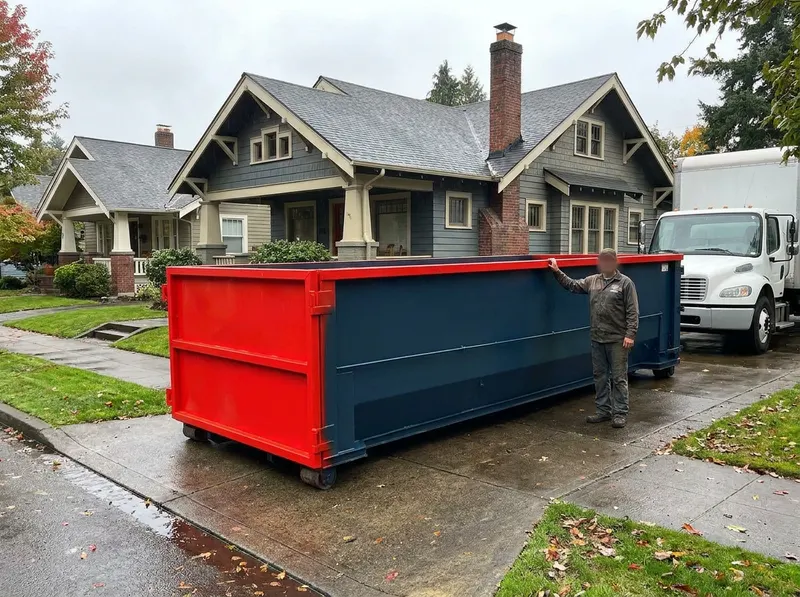
The 20-yard container measures about 22 feet long, 8 feet wide, and 4.5 feet tall, and its roughly 20 cubic yards equal about 8 pickup-truck loads. That capacity lands it between the 15-yard ($650), which suits a single bathroom or a small deck removal, and the 30-yard ($795), which suits a whole-house cleanout or a large siding job. A 10-yard ($595) fits a single-room remodel; a 40-yard ($895) fits new-construction framing waste. Choosing the 20-yard comes down to debris volume against driveway room: it needs about 22 feet of clear straight space plus roughly 10 feet of overhead clearance for the roll-off door to lift, which is why the mid-size bin is popular on the deeper lots of Laurelhurst and Multnomah Village and tighter on the narrow driveways near Alberta Arts District.
A dumpster rental is not junk removal, the crew drops the empty container and the customer loads it, which keeps the price down and the timing flexible. Weight still matters for what a roll-off can legally haul: Oregon road limits mean a heavy load of concrete, dirt, brick, or asphalt shingles should be split across a smaller bin or kept well below the fill line, and the Oregon Department of Environmental Quality (https://www.oregon.gov/deq/) sets the disposal rules the hauler follows at the transfer station. For a mixed renovation load of drywall, wood, and old cabinets, the 20-yard rarely approaches that limit. Materials banned from the box follow federal guidance on household hazardous waste (https://www.epa.gov/hw/household-hazardous-waste-hhw): no paint, solvents, motor oil, propane tanks, or vehicle batteries. Tires, appliances with refrigerant, and electronics are handled separately, e-waste in particular is covered by Oregon's product stewardship program, and Earth911 (https://earth911.com/) lists local drop sites for those items.
Step 1, call (503) 433-7112 or text a project photo and confirm the 20-yard fits the debris and the driveway. Step 2, pick a drop day and a placement spot, driveway, side yard, or street. Step 3, the roll-off truck lowers the empty container, often on plywood sheets to protect pavement. Step 4, the customer loads it level with the top rail over the rental period. Step 5, the truck returns on the scheduled pickup day and hauls it to the transfer station. If the 20-yard will sit on a public street in Sellwood-Moreland, St. Johns, Montavilla, or Hollywood rather than on private property, a right-of-way permit from the Portland Bureau of Transportation (https://www.portland.gov/transportation) is typically required, and that permit is arranged with the city, not bundled into the $695 rate. On most private driveways no permit applies.
Job-site loading follows the same safety habits OSHA outlines for construction debris (https://www.osha.gov/), keep heavy material low and distributed, and never stack above the rail, since an overloaded or mounded bin cannot be tarped or legally transported. Contractors managing a multi-trade remodel often cross-reference container sizing against industry guidance from the National Waste & Recycling Association (https://www.wasterecycling.org/), and crews running a certified green demolition can route reusable material through Metro's regional recycling guide (https://www.oregonmetro.gov/tools-living/garbage-and-recycling) before the rest goes in the box. For yard-heavy loads of branches and sod from a Woodstock or Irvington lot clearing, composting guidance from the US Composting Council (https://www.compostingcouncil.org/) explains why clean green waste is kept separate when possible.
Every job gets a firm, written price after an on-site visit.
Tell us about your 20-yard dumpster rental job in Portland and we'll send a clear, written quote, usually the same day.
 Top Shelf Dumpster Rental